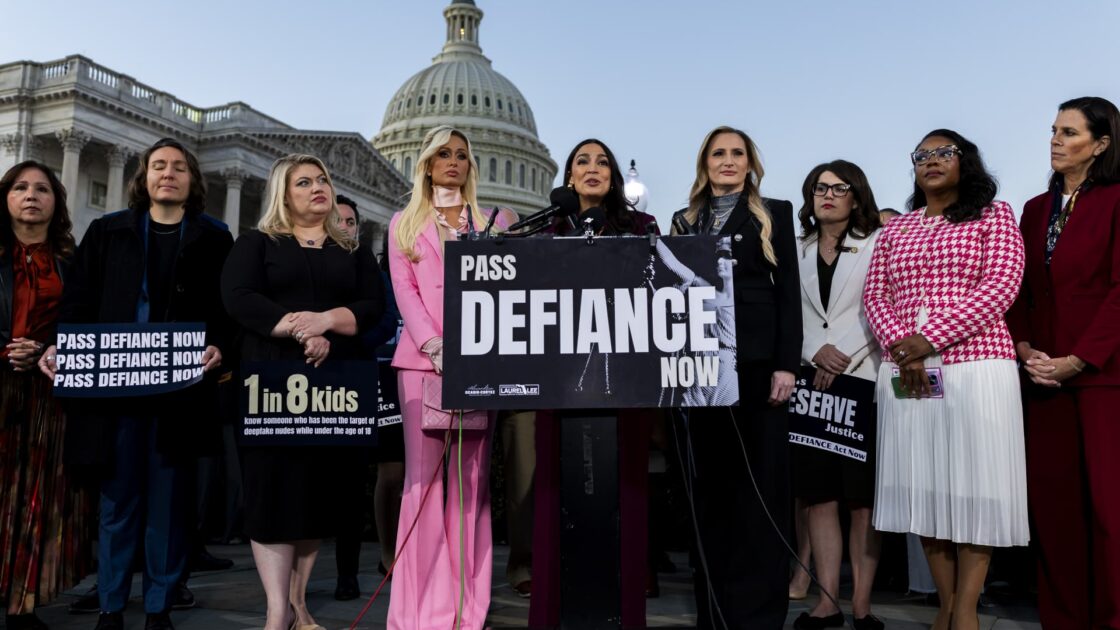
Paris Hilton and Representative Alexandria Ocasio-Cortez are pressing the House of Representatives to pass the Defiance Act to combat AI-generated deepfake pornography. Supporters say the legislation is urgently needed to fill legal gaps left by existing federal laws and to hold perpetrators accountable.
Advocacy and Personal Impact
Hilton currently works as the chief advocacy officer at digital identity protection firm Loti AI, which helps individuals find unauthorized uses of their likeness or voice online and submit takedown requests. She stated that her company has identified over 100,000 explicit deepfakes depicting her and successfully removed more than 60,000.
“I’m very fortunate that I have a team of lawyers. I have people helping me. But a lot of these young girls and women don’t have that support,” Hilton said, as reported by US Top News and Analysis (cnbc.com). “People need to know that there’s going to be consequences for their actions,” she added.
While the Take It Down Act made certain nonconsensual intimate image disclosures a federal crime and requires covered platforms to remove flagged material within 48 hours, critics note that it relies on federal prosecutors and lacks separate civil remedies. Texas Sen. Ted Cruz introduced that bill after an Instagram image of 14-year-old Elliston Berry was digitally altered to make her appear nude and circulated on Snapchat. Berry told CNN that she woke up to calls and texts about the widespread images, noting it was difficult to tell her mother even though she knew the edits were fake.
Hilton expressed concern as a mother about the circulation of such images among classmates, noting that the resulting pain and suffering are very real despite the images being synthetic.
Legislative Push and Industry Support
The Sexual Violence Prevention Association, which helped author the Defiance Act, delivered letters to House Speaker Mike Johnson and House Majority Leader Steve Scalise, urging them to bring the bill to the floor.
“I wrote the Defiance Act because survivors came to me with nowhere to go. Then, I was deepfaked by someone attempting to silence my advocacy for the Defiance Act. I was deepfaked while fighting for the very bill that would prevent it. Suddenly, I too had nowhere to go,” said Omny Miranda Martone, founder and CEO of the SVPA, in a statement. “Now it’s time for House leadership to say yes.”
The legislation has received 117 endorsements, including from tech companies like Microsoft, Snap, and OpenAI, alongside advocacy groups such as the National Organization for Women, the Center for Democracy and Technology, and the Center for AI Policy. OpenAI chief global affairs officer Chris Lehane called the measure smart legislation when the company endorsed it in June 2026.
The Senate has passed versions of the bill twice, in 2024 and January 2026, with original backing from senators including Dick Durbin, the late Lindsey Graham, Amy Klobuchar, and Josh Hawley. Ocasio-Cortez introduced the bipartisan House companion bill in May 2025, but it was referred to the House Judiciary Committee and has never received a vote.
House Speaker Mike Johnson told reporters in September that the measure is good policy, though the chamber has yet to build consensus. According to a Politico report from July, some Republicans were reportedly hesitant to advance the measure because its passage would give Ocasio-Cortez a legislative win ahead of the midterms.
The bill currently has 70 House cosponsors split evenly between Democrats and Republicans. Martone told US Top News and Analysis (cnbc.com) in an interview that she hopes post-election political blockages will ease because supporters have not encountered substantive opposition from representatives, big tech, or civil society organizations.
If the House fails to act before the current Congress ends, supporters will need to reintroduce the bill in the next Congress, where its trajectory will depend on the new makeup of the House and whether Democratic leaders prioritize the measure.