Table of Contents
As US President Donald Trump heads to China, his administration has announced new interim rules aimed at curbing Beijing’s access to advanced semiconductors. The measures will increase scrutiny of data center operators in Singapore, Malaysia, Thailand, Indonesia, and Brazil.
Restrictions on Computing Power and Chips
The policy restricts not only the export of advanced chips but also access to their computing power. Chinese firms frequently rent this overseas computing power to train artificial intelligence models.
South East Asian nations have invested heavily in data centers to power their artificial intelligence ambitions, with overseas Chinese firms serving as a key market. Under the new rules, these firms will require a US government license to purchase advanced chips from American makers like Nvidia. This enables Washington to monitor whether the chips serve Chinese companies or are smuggled into China.
This development creates a challenge for Beijing, which grew heavily dependent on foreign computing power following previous US export restrictions. Research by the US-based think-tank Institute for Progress projects that at least 30% of China’s advanced artificial intelligence computing power will come from overseas rentals or smuggling by 2027.
China’s foreign ministry labeled the new regulations economic coercion, stating that Beijing will take necessary measures to protect its legitimate rights and interests.
Impact on South East Asian Data Centers
The rules create difficulties for South East Asian economies that recently welcomed numerous data centers, as some operators face accusations of helping China evade US export controls.
Singaporean data center firm Megaspeed is accused of illegally smuggling chips to Chinese companies after buying them for facilities in Malaysia, Indonesia, and Thailand. Megaspeed’s former director, Alice Huang, is suspected of being a Chinese spy. Calls for stricter controls intensified after Nvidia’s Jensen Huang acknowledged an affair with her and resigned as chief executive officer.
Megaspeed denied the allegations, defended its business as legitimate and lawful, and stated it hired external legal counsel for an internal investigation. The company added that Alice Huang stepped down as a director in late 2023 and left the firm the following year.
The US Commerce Department’s Bureau of Industry and Security stated that Brazil and the four South East Asian countries present a higher-than-normal risk of diverting restricted chips to China. The bureau explained that the measures ensure sensitive US technology cannot be circumvented through remote computing arrangements in third countries, with licenses issued on a case-by-case basis.
Naoise McDonagh, an international trade expert at Australia’s Edith Cowan University, stated that countries like Malaysia and Thailand, where Chinese buyers heavily drove data center rollouts, could suffer the hardest impact. However, Reema Bhattacharya from advisory firm Verisk Maplecroft noted that the rules are unlikely to derail the overall data center boom, predicting that investments backed by major tech firms and clear customers will remain relatively resilient.
Singapore initially led in data centers, but as the island nation limited new construction, investments shifted to neighboring Malaysia and Thailand. Regions like Johor in Malaysia and Batam in Indonesia approved billions of dollars in data center projects to capture spillover demand, offering incentives such as cheaper land to attract foreign investment from Chinese tech giants like Alibaba and Tencent.
Singapore stated it is engaging relevant US authorities to understand the regulations and is exploring ways to facilitate trusted access for local firms. Brazil’s Ministry of Development, Industry, Trade and Services noted it is aware of the announcement and closely monitoring potential developments. Malaysia previously stated that while it welcomes data center investments, it will not allow itself to be used to bypass export controls. BBC News contacted Indonesia, Malaysia, and Thailand for comment.
Consequences for Beijing’s Tech Ambitions
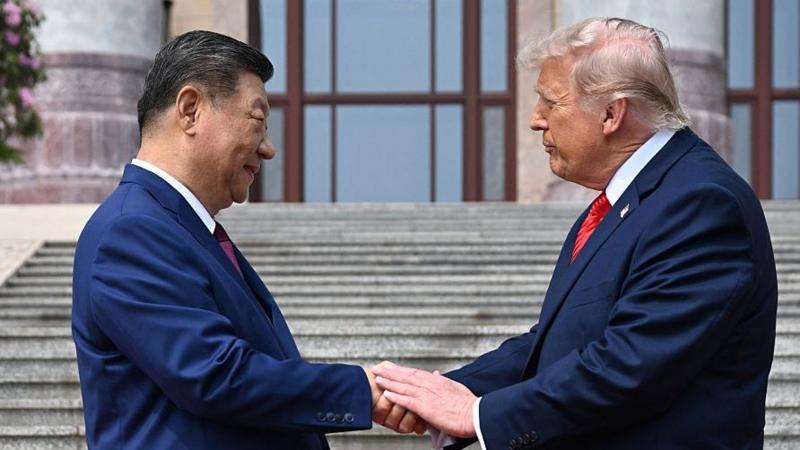
The new regulations coincide with Trump’s scheduled meeting with Chinese leader Xi Jinping in Shenzhen.
Beijing prioritizes national self-sufficiency in technology and requires top-tier chips to build powerful artificial intelligence models. Chinese firms DeepSeek and MoonShot developed models approaching the performance of US rivals Anthropic and OpenAI. The Institute for Progress estimates that top US artificial intelligence models lead leading Chinese platforms by only about six and a half months, despite US companies having superior computing access and financing.
Experts told BBC News that China still needs advanced US chips to keep its leading artificial intelligence models competitive. Bhattacharya noted that the restrictions on South East Asia and Brazil removed one of the most practical routes Chinese developers used to access frontier computing power.
McDonagh observed that tighter restrictions could alternatively push Chinese firms toward domestic semiconductors, further accelerating local innovation. This presents a longstanding dilemma for Washington regarding whether to continue selling chips to maintain Chinese reliance on the US or to restrict access and risk spurring domestic Chinese innovation.