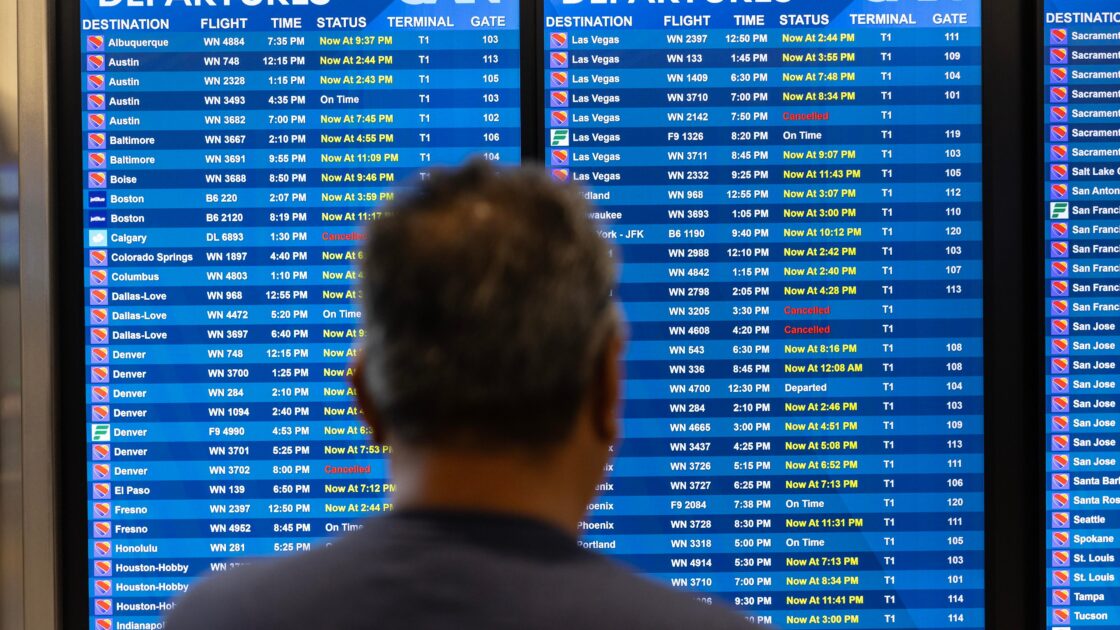
A communications failure at the Federal Aviation Administration on Friday, November 13, forced a nationwide ground stop across the United States. The incident stranded more than 1.5 million passengers and led to thousands of flight cancellations over the weekend.
A Nationwide Ground Stop and Cascading Failure
The communication issues began around 3:15 PM ET when pilots and air traffic controllers in the Midwest reported difficulties communicating over the radio. As outages spread, the FAA issued a nationwide ground stop at 3:54 PM ET due to extraordinary circumstances and safety reasons, halting all airplane departures in US airspace.
According to the agency, the failure stemmed from the FAA Telecommunications Infrastructure, or FTI, which serves as the data backbone of the air traffic control system. Built by defense contractor L3Harris in the early 2000s, the system links more than 4,400 aviation facilities and is scheduled to be replaced in 2028.
As The Wall Street Journal reported, an incremental upgrade accidentally brought down the network. L3Harris contractors replaced an old wired telephone switch with a new fiber data router at an FAA radio facility in El Dorado, Arkansas. Once activated, the router flooded the network with hundreds of connection attempts every second.
I-Hong Hou, a professor of electrical and computer engineering at Texas A&M University, explained that the degraded network began dropping data packets. Because air traffic control applications require highly reliable synchronization, losing small portions of data caused feeds to fail completely.
The repeated connection attempts created instability that cut off radio and radar feeds to 17 of the FAA’s 22 Air Route Traffic Control Centers and several Terminal Radar Approach Controls. Contractors eventually isolated the malfunctioning router along with another in Amarillo, Texas, allowing the FAA to lift the ground stop four and a half hours later at 8:15 PM ET.
Public Confusion and Political Fallout
The outage resulted in the cancellation of more than 13,000 flights and delayed over 25,000 more through the weekend, according to FlightAware. For six hours after the ground stop began, the agency provided minimal public updates before US Transportation Secretary Sean Duffy and Homeland Security Secretary Markwayne Mullin held a press conference.
The officials issued confusing and contradictory statements during the briefing. Mullin initially suggested that patching and new technology implemented by Duffy and the FAA had overloaded the older system, though he later walked back the remark. Duffy stated that the switches and routers became overloaded with data and exhibited inconsistent data, while declining to rule out nefarious activity.
During a subsequent press conference on Saturday afternoon, Duffy floated the possibility of contractor incompetence and demanded that Congress allocate billions more dollars to the FAA to complete its modernization efforts, calling the existing $12.5 billion budget a partial payment. The shifting explanations fueled online rumors regarding cyberattacks or rogue artificial intelligence.
Travelers like Amanda Khera, whose family vacation was disrupted when their connecting flight through Atlanta was canceled, faced severe disruptions. After spending the night in a hotel, Khera and her family rented a car and drove nine hours back to Virginia Beach, stating they plan to avoid flying for the next couple of months until the FAA provides more explanations.