Table of Contents
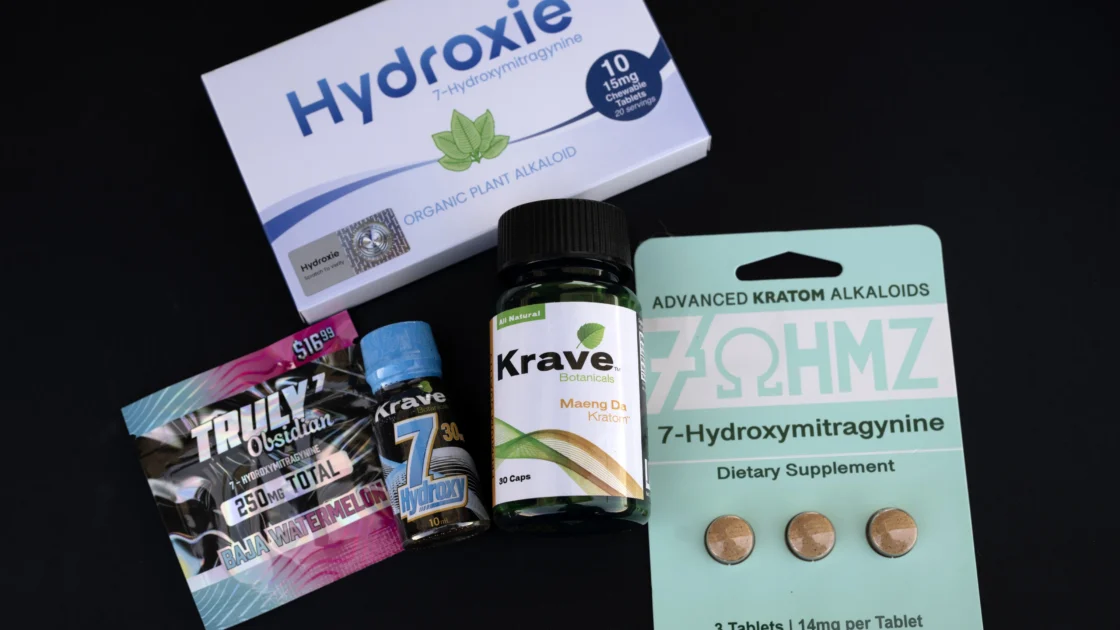
Kratom and related 7-OH products are widely available at gas stations, smoke shops, liquor stores, and online, sitting at the center of a growing public health debate. While some consumers credit the substances with helping manage chronic pain, mood issues, or opioid addiction, researchers and recovering users warn of potent and debilitating addictive properties. As early as Friday, the federal government could implement new restrictions targeting specific concentrated versions of these products.
The Rise of 7-OH and Public Health Concerns
7-OH, or 7-hydroxymitragynine, is one of the major psychoactive ingredients found naturally in very small amounts within kratom, which comes from a tree in the coffee family. Unlike traditional whole leaf kratom, 7-OH appears to act more like an opioid in the human brain. In recent years, highly concentrated 7-OH products—such as tablets, gummies, tonics, and chocolates—have flooded the market. Estimates suggest over 5 million to as many as 15 million people in the U.S. have used kratom in their lifetime, though general statistics often fail to distinguish between whole leaf kratom and potent 7-OH derivatives.
Data from 53 U.S. poison control centers analyzed by researchers indicate that calls related to kratom surged by about 1,200% between 2015 and 2025. Chris Holstege, a professor of emergency medicine and pediatrics at the University of Virginia’s School of Medicine and a co-author of the report, stated that he and his team were stunned by the findings. While the report logged 233 deaths associated with kratom during that decade where 79% involved multiple substances, over half of the total calls involved individuals consuming kratom without any other drugs.
Divided Experiences: Relief Versus Severe Withdrawal
Consumers report vastly different experiences with these substances. Angela Wilson, a 44-year-old resident of Delaware without health insurance, told NPR that taking 32 to 40 milligrams of 7-OH daily has been life-changing for managing severe chronic pain from endometriosis and lifelong depression symptoms, noting that losing access would be devastating. Conversely, other users recounted severe dependency cycles. Tyler, a 38-year-old who used kratom to quit opioids a decade ago, tried 7-OH tablets thinking they were standard kratom. He quickly escalated to 300 to 400 milligrams a day, describing the euphoria as a miracle before finding himself in a rapid detox program in Michigan after failing to stop on his own.
Another former consumer, 41-year-old Brian, shared that at the height of his use, he consumed 1,200 milligrams of 7-OH daily and spent around $150 a day on the substance. He stated that the tablets provided an effect akin to Oxycontin and called the accessibility a nightmare when he attempted to quit. David Epstein, a senior investigator at the National Institute on Drug Abuse Intramural Research Program, noted that ongoing research suggests the risk of dependency is higher with 7-OH products compared to whole leaf kratom, with some users needing to wake up in the night to dose and avoid withdrawal.
Impending Federal Restrictions
The federal government has repeatedly attempted to restrict kratom and 7-OH over the last decade, facing strong pushback from the public and advocacy groups. However, the regulatory landscape has shifted. In August, the Drug Enforcement Administration restricted three semi-synthetic opioids derived from 7-OH—MGM-15, MGM-16, and mitragynine pseudoindoxyl (MGPI)—under the Controlled Substances Act. Following a federal lawsuit from the American Kratom Association and a subsequent recommendation from the U.S. Department of Health and Human Services, the DEA adjusted its approach to focus on products with higher concentrations of 7-OH and MGPI while leaving natural, traditional botanical kratom untouched.
Researchers emphasize that further study is necessary to determine whether kratom and its compounds can serve as legitimate experimental treatments for substance use disorders. Meanwhile, Holstege observed that the proliferation of retail shops marketing these items suggests they are drawing consumers for reasons far beyond treating opioid addiction. Brian and Tyler both reported experiencing intense, prolonged withdrawals characterized by anxiety, fear, and gastrointestinal distress upon quitting cold turkey, with Tyler noting that recovering his energy levels after stopping 7-OH took months of sustained effort.