Maia Bittner needed to replace her car’s windshield wipers last month and turned to Meta’s Muse personal artificial intelligence agent to buy them from AutoZone. About 17 hours later, she received a notification saying AutoZone canceled her order due to an unspecified error, with the agent advising her that ordering on Amazon directly was more reliable.
The Patchwork of Permissions and Retailer Pushback
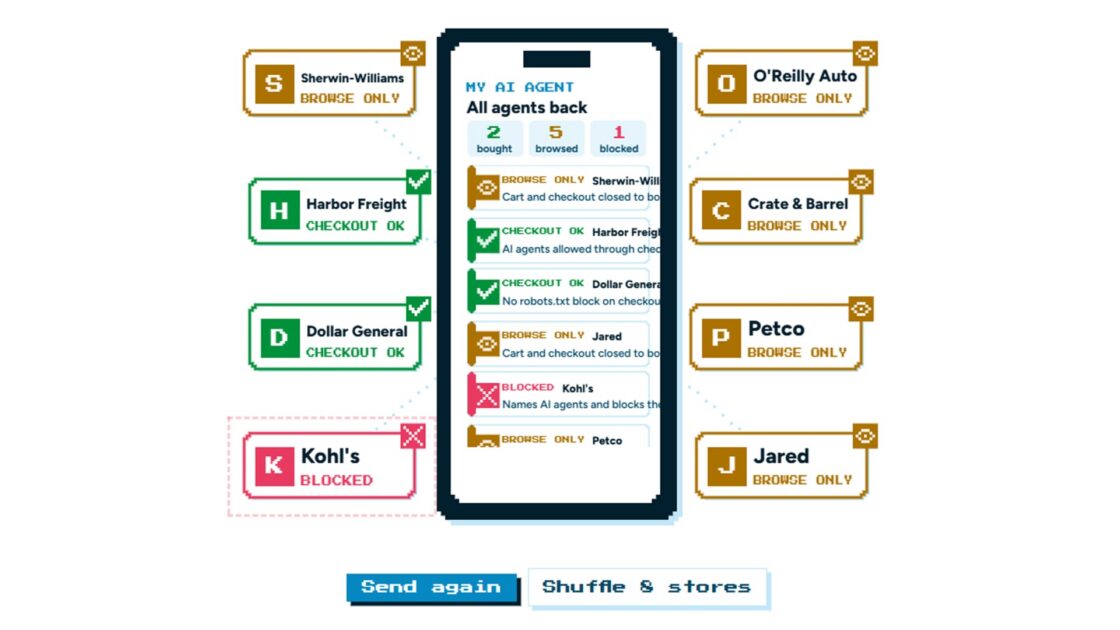
The interaction highlights the messy landscape of agentic shopping apps designed to purchase items for users. Over the past year, tech companies like OpenAI, Meta, Google, and Instinct introduced personal agents meant to simplify online shopping, but the rollout has faced friction as major platforms respond differently. While Walmart and Sephora opened their sites to agents, Amazon, eBay, United Airlines, and Kohl’s block them or limit their actions, and some add terms stating they are not liable for AI purchase errors. Forrester principal analyst Emily Pfeiffer noted in an interview with US Top News and Analysis (cnbc.com) that consumers using agents will not see a full set of options because some sites are unavailable.
Retailers face various issues with bots, which often struggle with web navigation and login requirements at checkout, sometimes requiring human intervention to pass Captcha tests. A Visa study from earlier this month tested 22 models from 12 AI labs on shopping tasks like buying a TV, laptop, or hair appliance. The agents failed about 43% of test runs, and in over half of those failures, the agent bought a product failing to meet the customer’s requirements, as reported by US Top News and Analysis (cnbc.com). Amazon has responded most aggressively by walling off its site, blocking Elon Musk’s Grok Bot, preventing Meta’s Muse from shopping, and suing Perplexity over its Comet agent. Amazon CEO Andy Jassy stated the company expects to partner with third-party agents over time when the right value exchange is established.
Fraud Concerns and Future Outlook
Retailers remain cautious about fraudulent bot activity because agents mask their IP addresses via data centers and use one-time virtual cards. Skyfire CEO Amir Sarhangi explained in an interview with US Top News and Analysis (cnbc.com) that retailers lack the usual human verification signals when an agent accesses a site. Financial institutions and tech companies are proposing protocols to make transactions easier, while responsibility rules remain unclear. American Express announced protection against AI agent errors, and Stripe offers a refund guarantee, whereas JPMorgan Chase blocked external agents for security, and Best Buy places full responsibility on the user.
Agents currently remain a niche tool, accounting for just 0.4% of global e-commerce transactions and 0.2% of value, according to Bain & Co. research. Uber, Airbnb, and DoorDash reported very low volume from AI agents during recent periods. However, tech executives remain optimistic, with Meta CEO Mark Zuckerberg noting in October that about a quarter of Muse’s 10 million users shop online via AI agents with an average spend of $200 per order, and Instinct CEO Noah Shinn reporting an average transaction value exceeding $500 per person.