The high-profile reinstatement of Chief Executive Officer Jensen Huang at Nvidia has caused significant fluctuations across global technology markets. Stock indexes in Taiwan, South Korea, and Japan experienced sharp swings as investors reacted to both the company’s surging valuation and emerging political challenges in the United States.
Asian economies have tied their growth strategies directly to the artificial intelligence boom, leaving them deeply reliant on Nvidia’s business trajectory. Dylan Loh, an international studies lecturer at Nanyang Technological University, told BBC News that the chipmaker functions as a critical indicator for the tech sector across Singapore, Malaysia, South Korea, and Taiwan.
Deep Regional Ties and Supply Chain Dependence
Nvidia has established a dominant market position by contracting its manufacturing operations to external partners rather than operating its own fabrication plants. Taiwanese semiconductor giant TSMC manufactures the majority of Nvidia’s advanced processors. Paul Cavey, founder of research firm East Asia Econ, noted that Taiwan’s recent economic expansion has been significantly driven by the rapid rise in artificial intelligence exports. Huang previously stated that Nvidia intends to invest approximately $150 billion (£114.4 billion) annually in Taiwan to support its local operations.
Other Asian economies play essential roles in supplying critical hardware components to the U.S. chipmaker. South Korean firms Samsung and SK Hynix provide high-bandwidth memory chips, while Japanese companies supply essential semiconductor testing equipment. Loh explained to BBC News that East Asian manufacturing ecosystems serve as an indispensable production engine behind Nvidia’s global market leadership.
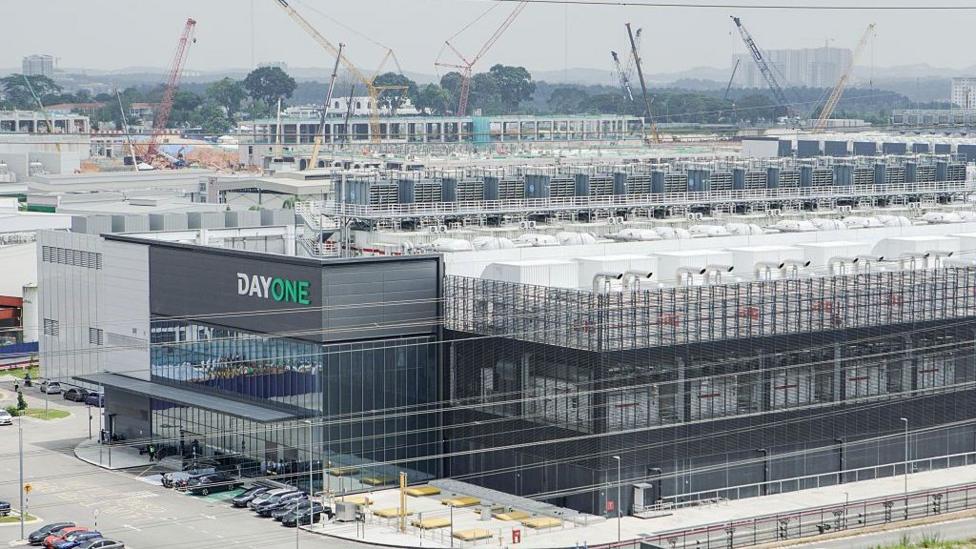
Infrastructure investment is expanding at a rapid pace throughout the region. Property service company CBRE reported that funding for Asia-Pacific data centres is projected to hit a record $11.6 billion (£8.85 billion) in 2025. Major technology companies including Microsoft, Google, and Oracle are increasing their regional infrastructure spending by nearly 60 percent this year to meet growing demand for specialized artificial intelligence processing facilities.
However, the rapid expansion has also created regulatory complications. Megaspeed, a Singapore-based enterprise that became the region’s largest buyer of Nvidia processors, faces impending U.S. sanctions over allegations of illegally shipping chips to China. Megaspeed stated that it “conducts legitimate and lawful business” and has “retained external legal counsel to conduct a thorough internal investigation.”
Regulatory Pressure and Political Uncertainty
Regulatory scrutiny from Washington presents growing operational challenges for Nvidia’s partners across Asia. Both the Biden and Trump administrations have systematically restricted foreign sales of high-performance artificial intelligence chips. Recent U.S. directives expanded oversight to data centre operators located in Singapore, Malaysia, Thailand, Indonesia, and Brazil, blocking Chinese entities from renting cloud computing capabilities located outside China.
Following the new restrictions, the Financial Times reported that Nvidia temporarily halted hardware shipments to Southeast Asia while assessing compliance protocols. The company did not immediately respond to requests for comment regarding the disruption.
Political developments in the United States have added further uncertainty. President Donald Trump publicly claimed credit for negotiating Huang’s reinstatement to Nvidia’s leadership, triggering bipartisan criticism in Washington. Saxo Bank chief investment strategist Charu Chanana observed that while Huang’s return resolved the immediate corporate crisis, it did not eliminate underlying legal and regulatory risks.
Huang is scheduled to present testimony before the U.S. Congress next week. Constellation Research founder Ray Wang stated to BBC News that congressional lawmakers are likely to conduct rigorous inquiries into the leadership situation, noting that significant political and legal questions surrounding the company remain unresolved.