Tens of millions of people faced travel disruptions on highways and at airports nationwide on Thursday as powerful storms swept across the United States during the Thanksgiving holiday. AAA projected that roughly 81.5 million people would travel for the holiday between Thursday and Monday.
Impact on Travel and Coastlines
On the West Coast, high tides flooded streets along California shorelines, damaged part of the Pacifica Pier, and triggered evacuation warnings. Meanwhile, a storm moving up from the southeast into New England brought strong winds, heavy rain, and coastal flooding to the East Coast, while snow was forecast in parts of the Midwest. Hundreds of flights were canceled or delayed by early Thursday morning, particularly along the East Coast where authorities urged residents to stay home. Because the majority of holiday travelers drive, winter weather also threatened to create dangerous visibility issues on roadways.
Richard Bann, a meteorologist with the National Weather Service Weather Prediction Center, told NPR that the East Coast system was a primary concern as a “multi-hazard” storm. Bann explained that the system would organize throughout the day, bringing considerable wind, heavy rain, and significant coastal flooding. Matthew Cappucci, a meteorologist with The Washington Post and MyRadar, told NPR that the magnitude of the storm for this time of year was unusual, noting that such conditions would normally be expected in deep winter. Forecasters anticipate the East Coast storm will largely clear out by Saturday, improving weekend conditions for travelers returning home.
Macy’s Thanksgiving Day Parade Postponed
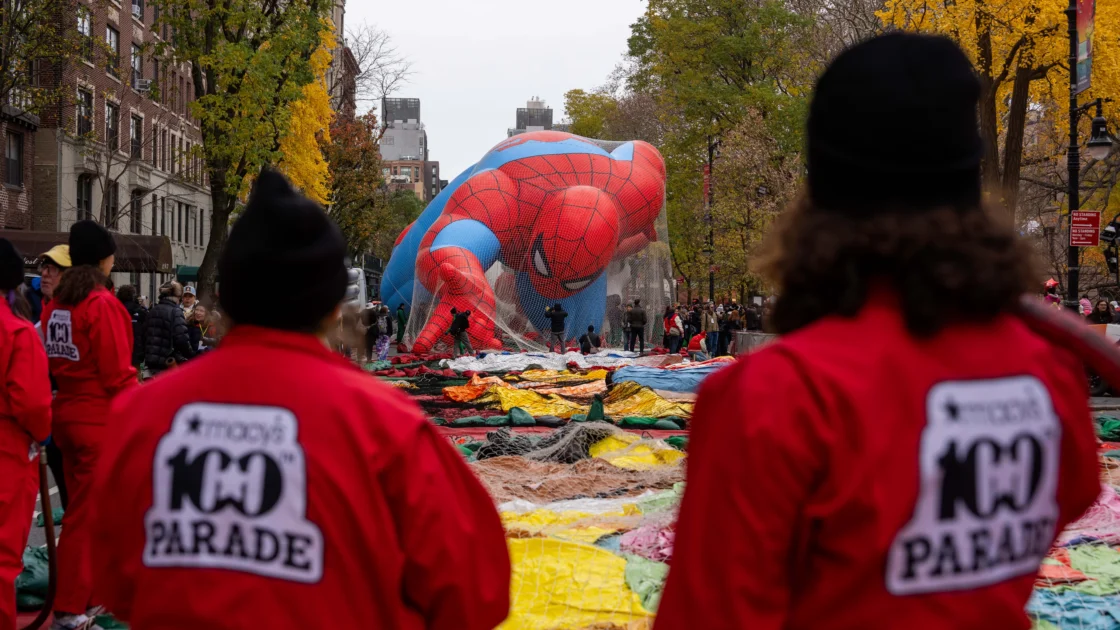
Severe weather also forced adjustments to holiday celebrations, including the postponement of the famous Macy’s Thanksgiving Day Parade in New York City. New York City Mayor Zohran Mamdani announced the delay on Wednesday after high winds threatened the event’s iconic giant balloons while workers were inflating them. The parade, marking its 100th anniversary, has been rescheduled for Saturday, November 28, representing the first time in its century-long history that the event will occur on a day other than Thanksgiving. While the parade was previously canceled during World War II, it has never before been postponed.
Organizers spent two years preparing the milestone celebration, which features more than 11,000 participants and volunteers, thousands of high school marching band musicians, and hundreds of balloon handlers, drawing up to 2 million spectators in past years. Mayor Mamdani told reporters that safety remains the top priority in the face of a heavy storm. Mamdani advised residents to prepare for extreme conditions, citing expected sustained winds of 30 to 40 mph, potential gusts reaching 65 mph, and associated floods and flash floods. Acknowledging the disappointment of altering tradition for characters like SpongeBob, Spider-Man, and Garfield, Mamdani emphasized that safety must come first. In Philadelphia, similar wind conditions prompted officials to ground all balloons for the city’s holiday parade.