Five years after NASA intentionally crashed its DART spacecraft into the asteroid Dimorphos to test planetary defense, the European Space Agency has published new images revealing the extent of the damage. The historic 2022 mission successfully altered the orbit of Dimorphos, making it the first celestial object moved by humans, while the recent photos from the ESA’s Hera spacecraft show the impact was far more destructive than initially estimated.
Uncovering Massive Destruction and Tumble
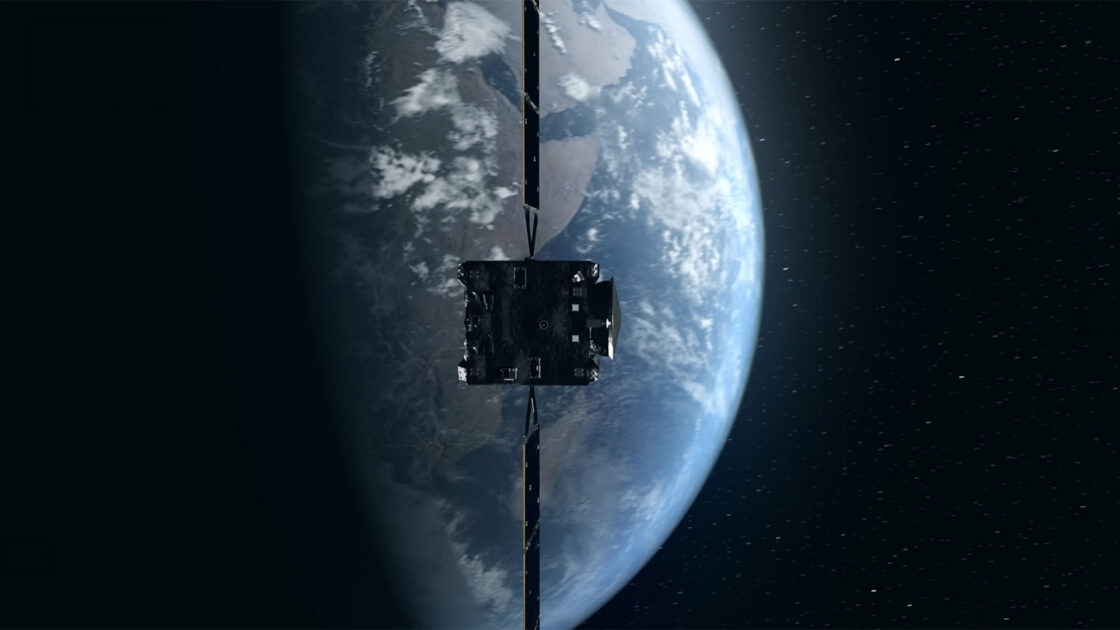
The ESA livestreamed the presentation, showcasing images captured by Hera, which launched in October 2024 and spent two years traveling through deep space with two CubeSats to map and study the target. At the time of the collision, only the Hubble Space Telescope and ground-based telescopes could observe the impact, leaving scientists unable to assess the true scale of the damage. Hera’s new data revealed that instead of creating a predicted 20-meter crater, the impact blew off nearly the entire end of Dimorphos, leaving a football stadium-sized crater as wide as the asteroid itself.
Furthermore, the Hera mission discovered that Dimorphos no longer remains tidally locked to its larger companion, Didymos. ESA Hera Mission Specialist Michael Kueppers noted during the presentation that the asteroid now spins in a completely erratic manner. ESA mission manager Ian Carnelli pointed out that this unexpected tumbling is actually advantageous because it allows Hera to observe all sides of Dimorphos.
During the presentation, the ESA team also addressed an unexpected abundance of debris surrounding the two asteroids. Although engineers believed all debris would be ejected or reabsorbed before Hera arrived, researchers identified over 100 boulders marked as white dots in the imagery. Kueppers expressed enthusiasm over the incorrect prediction, noting that scientists are always pleased to have new challenges to study.
Assessing Planetary Defense Capabilities
The primary objective of the DART mission was to evaluate whether humanity could deflect a hazardous asteroid through a kinetic impact, functioning as a planetary defense test. While NASA originally hoped to shorten the orbit of Dimorphos by at least 73 seconds, the actual orbit was shortened by 33 minutes and 15 seconds. Researchers determined that the massive cloud of debris acted as extra recoil, amplifying the push against the asteroid.
The altered orbit around Didymos also shifted the orbit of both asteroids around the sun by about 11.7 microns per second. Although this shift sounds minimal, it accumulates to roughly one kilometer every 2.7 years, demonstrating a viable method for steering dangerous asteroids away from Earth if given sufficient time. Lori Glaze, director of NASA’s Planetary Science Division, stated in a 2022 release that the incoming data helps astronomers evaluate how missions like DART can protect Earth from potential future asteroid collisions.
These initial discoveries were made only 20 days into Hera’s six-month mission, with the research team anticipating further images and insights in the coming months.