Table of Contents
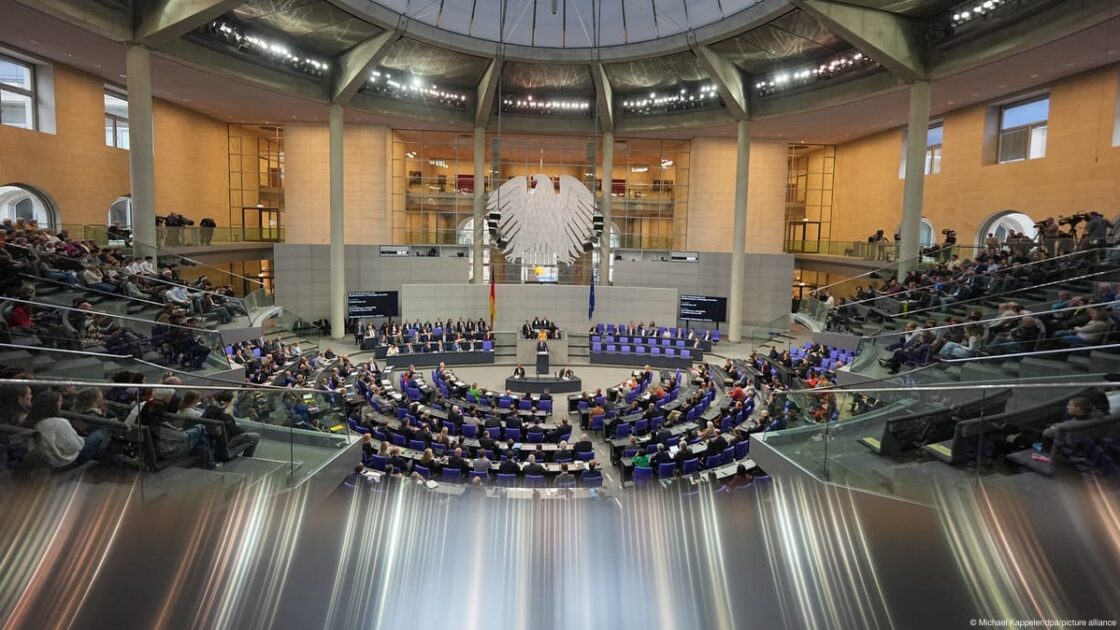
Lawmakers in the Bundestag are holding four days of final debates on Germany’s federal spending for the coming year. While the government defends its plans, doubts have emerged within the ranks of the ruling coalition parties, consisting of the conservative Christian Democratic Union (CDU), the Christian Social Union (CSU), and the center-left Social Democratic Party (SPD).
Record Spending and Historic Debt Levels
Chancellor Friedrich Merz acknowledged in the Bundestag on Wednesday that the country faces a difficult geopolitical, technological, and demographic situation, which is reflected in the upcoming budget. He warned that without a change of course, future federal revenues will be entirely consumed by social programs, interest payments, and defense.
After roughly 20 months in office, the government is facing financial strain. Although Merz initially promised to restore adherence to the constitutional debt brake, spending for 2027 will reach a record €561 billion ($614 billion). With tax revenues falling short, Germany faces record new borrowing totaling €210 billion for the year.
The opposition far-right Alternative for Germany (AfD) calculated that the government will incur €401,000 in new debt every minute next year. During the debate, AfD co-leader Tino Chrupalla criticized the plan as a debt orgy that will paralyze the country, claiming Merz will go down in history as the chancellor who led Germany to bankruptcy.
Defense and Ukraine Funding Controversies
Germany’s budget deficit has only been higher during the COVID-19 pandemic, driven by a struggling economy, an aging population, and Russia’s ongoing war against Ukraine. The defense budget for 2027 is set at a historic €109 billion, marking an increase of €27 billion from the previous year. Combined with a multi-year, debt-financed special military fund, total defense spending reaches €139 billion.
The AfD and the socialist Left Party sharply criticized these allocations. Left Party parliamentary leader Heidi Reichinnek accused the government of pursuing militarization and boundless rearmament alongside brutal social cuts. The AfD’s Chrupalla also targeted financial aid to Ukraine, contrasting a temporary electricity tax reduction for families with a large check given to Ukrainian President Volodymyr Zelenskyy.
The opposition Greens defended support for Ukraine. Green Party Bundestag member Britta Haßelmann dismissed the AfD’s stance as shameful, arguing that aiding Ukraine reinforces security for both Germany and Europe.
Chancellor Merz echoed this sentiment, stating that Russia wants more than just Ukraine and is escalating tensions in the Baltic region, Poland, the Black Sea, and space, while also seeking escalation within Germany. He emphasized that the nation must show Russia its limits.
Social Spending and Pension Reform Debates
Despite rising defense and international commitments, social welfare remains the largest single budget item. The Ministry of Labor and Social Affairs budget is rising to over €200 billion, even with cuts to unemployment benefits. Germany’s pension system faces urgent pressures as the generation born in the 1960s approaches retirement, while birth rates declined significantly in the following decades.
In 2025, the government contributed €127 billion toward the €420 billion paid out in pensions. For 2027, the government aims to save €3 billion in this area, which is expected to drive up pension contributions further. Chancellor Merz warned in the Bundestag that tax revenues will eventually no longer cover all accustomed expenditures, stating that coalition partners will have to give up some cherished ideas.
Meanwhile, the SPD is pushing to increase federal revenue. SPD parliamentary leader Matthias Miersch argued in the Bundestag that large fortunes, inheritances, and major companies must contribute more to public costs. He noted that heirs to family-owned businesses often pay significantly less in taxes than heirs to real estate or financial assets, and stated that taxing the wealthy more is firmly on the agenda.
Political differences between the CDU/CSU and the SPD are expected to complicate governance further, particularly with multiple state elections scheduled for the spring. Chancellor Merz expressed confidence that better collaboration remains possible through compromise among the coalition partners.