Table of Contents
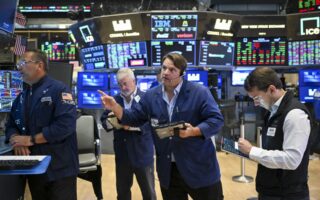
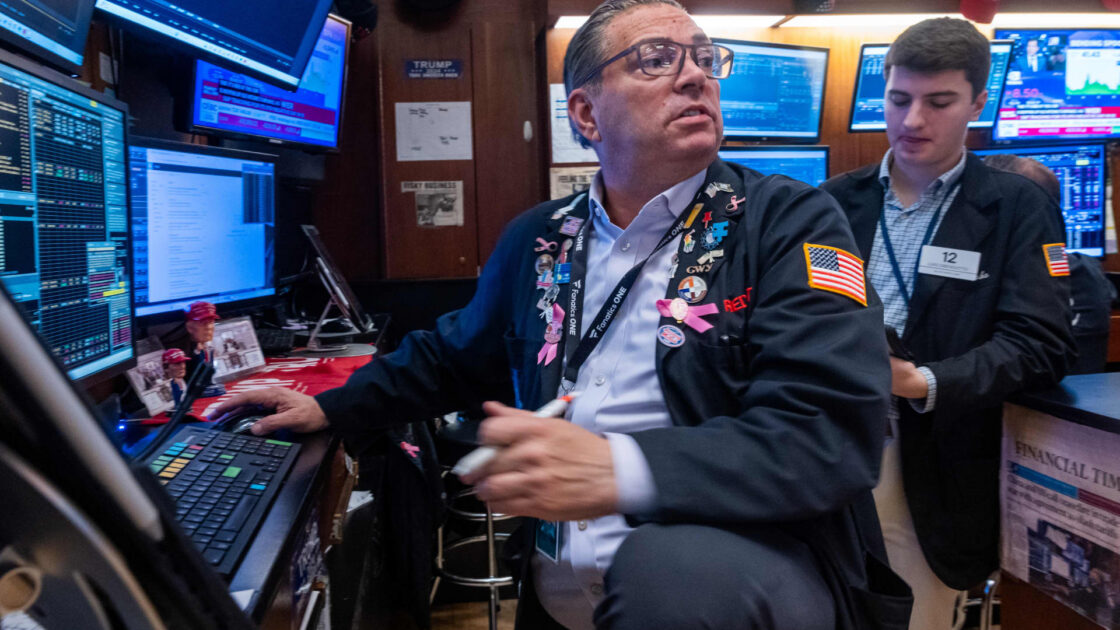
The Dow Jones Industrial Average finished Wednesday’s session in positive territory, gaining 164.25 points, or 0.33%, to close at 50,182.95. The recovery marked a significant turnaround for the market, which had seen the S&P 500 drop as much as 3.2% and the Nasdaq fall 4.6% earlier in the day.
Market Volatility and Sector Performance
Despite the Dow’s gains, the broader market remained under pressure. The S&P 500 ended the day down 0.25% at 7,182.78, while the tech-heavy Nasdaq Composite fell 0.62% to 23,585.80. The CBOE Volatility Index, often called Wall Street’s “fear gauge,” rose above 30, reflecting heightened investor anxiety.
The technology sector led the decline, with the VanEck Semiconductor ETF (SMH) on track for its worst 10-day performance since April 2025. Information technology, consumer discretionary, and communication services were the primary laggards, while consumer staples and real estate were the only S&P 500 sectors to trade in the green. Deutsche Bank’s Jim Reid noted that a “risk-off tone” had returned to the market, though he observed a rotation into defensive sectors rather than an indiscriminate sell-off.
Nvidia and AI Industry Developments
Nvidia remained a focal point as S&P Global placed the company on “CreditWatch Negative,” citing concerns regarding board independence and “key man” risk following the recent exit and reinstatement of CEO Jensen Huang. Shares of Nvidia fell 4% in pre-market trading.
In other AI-related news, SpaceX received FCC authorization to launch 1 million artificial intelligence computing satellites, causing its shares to rise more than 1%. Meanwhile, Anthropic shares fell 4.6% in pre-market trading, dropping below its $83 IPO price.
Economic Data and Trade Policy
Inflation concerns persisted as the personal consumption expenditures (PCE) price index rose 3.8% in October, up from 3.7% the previous month. Excluding food and energy, the index advanced 3.3%, slightly exceeding the 3.2% consensus forecast. Treasury yields slid as investors sought the safety of bonds, with the 10-year note yield falling more than 7 basis points to 4.824%.
The U.S. government announced new tariffs on 14 trading partners, including China, the European Union, and Japan, to combat industrial “overcapacity.” The measures, implemented under Section 301 of the Trade Act of 1974, include a 20% tariff on China on top of existing duties. Additionally, Xiamen Airlines agreed to purchase 50 Boeing 737-8 aircraft in a $7.4 billion deal, following discussions between President Donald Trump and Chinese President Xi Jinping.
Global Economic Outlook
International markets faced significant headwinds. In Asia, the Kospi in South Korea plunged over 6%, while Japan’s Nikkei 225 fell 2.78%. European markets saw a mixed open, though tech stocks continued to struggle. Data from McKinsey indicated that 45% of European industrial firms are experiencing financial stress, while Germany’s third-quarter GDP growth was revised downward to 0.1%.
In the United Arab Emirates, Economy Minister Abdulla bin Touq Al Marri expressed optimism, stating the country is “ready for any storm” after the IMF revised its 2026 growth forecast upward. Meanwhile, a Swiss parliamentary committee advanced a plan for stricter capital requirements for UBS, a move the bank warned would result in excessive tightening.
In legal developments, a federal jury convicted Chinese technology giant Huawei on multiple criminal charges, including fraud and conspiracy to steal trade secrets. Separately, the New York Post reported that President Trump indicated he would be willing to pardon Nvidia CEO Jensen Huang if necessary, though he noted he did not believe such action would be required.