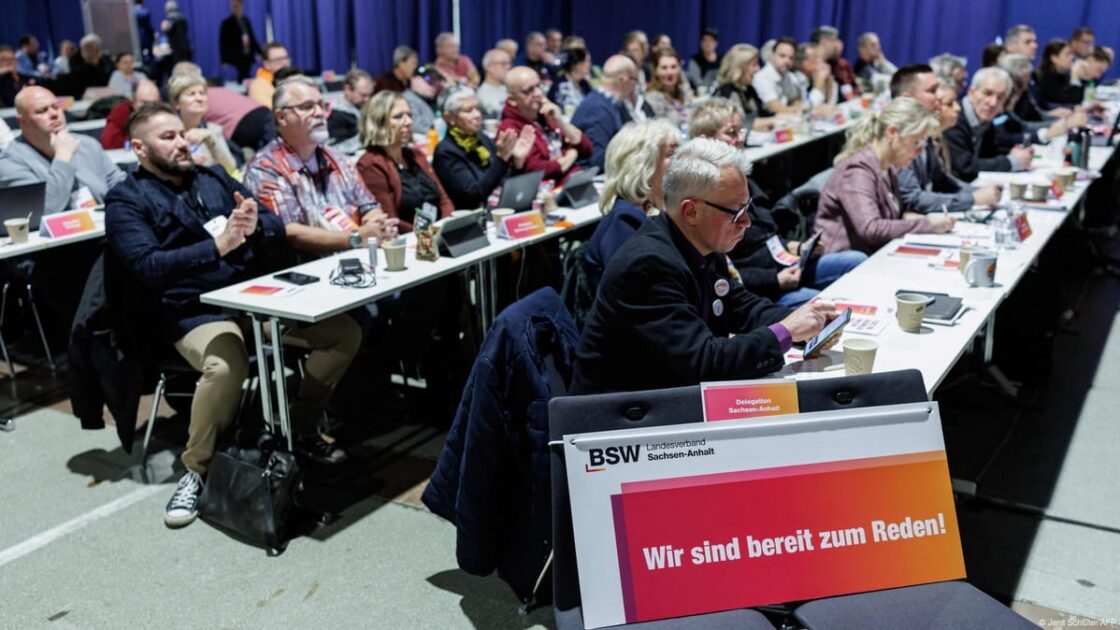
Germany’s left-wing populist party BSW has voted against a measure that would have restricted cooperation with the far-right Alternative for Germany (AfD) party at the federal level. The decision was made during a party conference in the eastern city of Dresden, where delegates rejected a proposal from founding members calling for a clearer distinction from the far right.
BSW Party Dynamics and the “Magdeburg Model”
The debate followed the AfD’s success in September’s state election in Saxony-Anhalt, where it secured 39 seats. In October, AfD member Tobias Rausch became the first far-right state parliament speaker in Germany since World War II. With the BSW holding five seats, the two political extremes could combine for a majority of the 83 seats.
BSW founder Sahra Wagenknecht and party leader Fabio De Masi have supported the “Magdeburg Model,” named after the state capital. This approach rejects formal coalitions and support for an AfD candidate as state premier, but allows for joint motions, shared voting, and potential written agreements.
Wagenknecht stated during the conference that she does not view the AfD as a long-term strategic partner, emphasizing that nobody in the party wishes to cozy up to them. However, she defended selective cooperation, stating that the party must utilize windows of opportunity for practical improvements when reasonable majorities arise on issues like peace and social reform. Both parties share skeptical views on military support for Ukraine and sanctions against Russia.
Conversely, BSW executive board members such as Christian Leye, Amid Rabieh, and Klaus Ernst sought to explicitly rule out coalitions, formal tolerance, and long-term cooperation agreements. Leye criticized the possibility of partnership, labeling the AfD a racist and nationalist party with democratic issues. Ernst warned he might leave the party if a clear line was not drawn against the far right. Germany’s domestic intelligence agency classifies the AfD as right-wing extremist.
Victims of Terrorist Attacks and Economic Updates
Federal Victim Commissioner Roland Weber reported that Germany has disbursed approximately €16.5 million ($18 million) to victims of terrorist and extremist attacks since the 2016 Berlin Christmas market truck attack. Weber noted that nearly 3,000 people have been affected by these attacks, with close to €4 million distributed in hardship funds following the Berlin incident alone. Support letters were also dispatched quickly to individuals impacted by the December 20, 2024, attack on a Magdeburg Christmas market.
In the automotive sector, the German Motor Trade Association (ZDK) forecasts that electric vehicle sales will exceed 1 million in 2027, following an estimated 840,000 sales in 2026. ZDK President Thomas Peckruhn cited growing model ranges and government subsidies as key drivers for this momentum, alongside a predicted 2.5% rise in total passenger car sales to 3.05 million.
Meanwhile, Federal Employment Agency (BfA) head Andrea Nahles warned that the German job market is unlikely to experience a noticeable recovery before early summer. Nahles highlighted that the number of employees paying social insurance contributions has plateaued at around 34 million. She emphasized that demographic shifts and skilled worker shortages pose the primary challenge, noting there are 13 unemployed individuals for every unskilled opening compared to two open positions for every skilled worker, making skilled immigration essential.