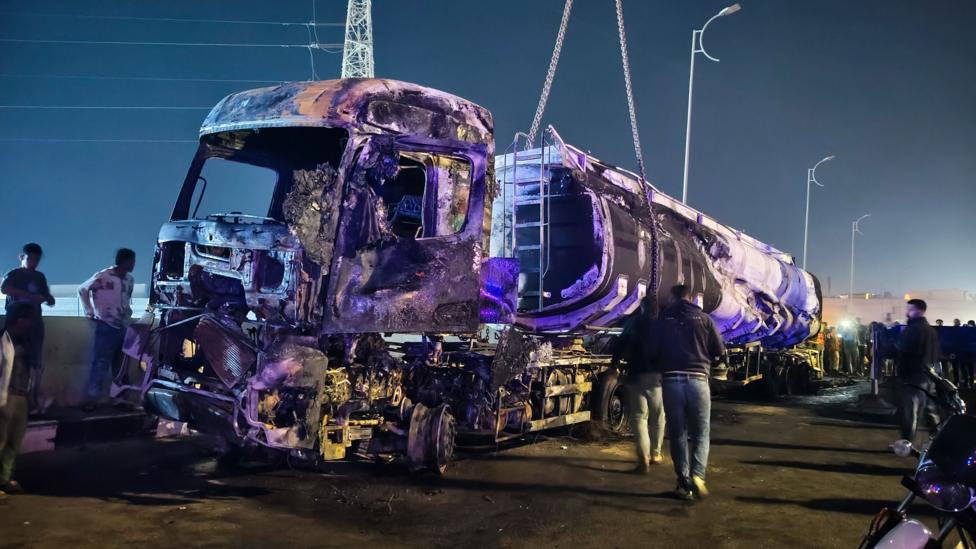
Egyptian authorities have arrested a man accused of causing a horrific tanker crash and massive fire on a busy Cairo highway that resulted in 31 deaths.
Crash Investigation and Confession
The public prosecutor’s office stated that the motorist confessed to driving at 110km/h (68mph) along a ring road section north of the old city centre. According to the prosecutor’s office, the driver admitted that while switching traffic lanes and overtaking other vehicles, the left side of his car struck the right rear section of the fuel tanker.
Investigators initially heard from sources close to the inquiry, as quoted by state media, that a high-voltage cable had dropped in front of the fuel truck, forcing the driver to lose control. However, the prosecutor’s office detailed that the impact from the car caused the motorist to lose control of his steering wheel, sending his vehicle veering to the far right of the road.
Concurrently, one of the fuel tanker tires burst, leading the truck to veer into the highway central reservation, strike the concrete barrier, and overturn. The accident caused fuel to spill and ignite a massive fire.
Casualties and Aftermath
The collision, which took place in the Warraq neighborhood on Wednesday evening, also left 21 other people injured. Hospitals provided treatment to patients suffering from severe burns and smoke inhalation.
Authorities have withheld the name of the suspect, though officials noted he was traveling alongside his father when the crash happened. Emergency services managed to reopen the elevated motorway—a vital traffic artery around the capital—hours after the incident, utilizing bulldozers and diggers to clear burnt vehicle wrecks to the roadside.
Government response efforts included a cabinet minister announcing a donation of 10 million Egyptian pounds (£139,000; $182,000) to support the victims’ families. Additionally, the national sports minister declared the cancellation of all state-run celebratory activities following the tragedy.
Egypt has experienced multiple fatal fires in recent years, alongside frequent road collisions driven by poor infrastructure maintenance and traffic law violations that claim thousands of lives annually.