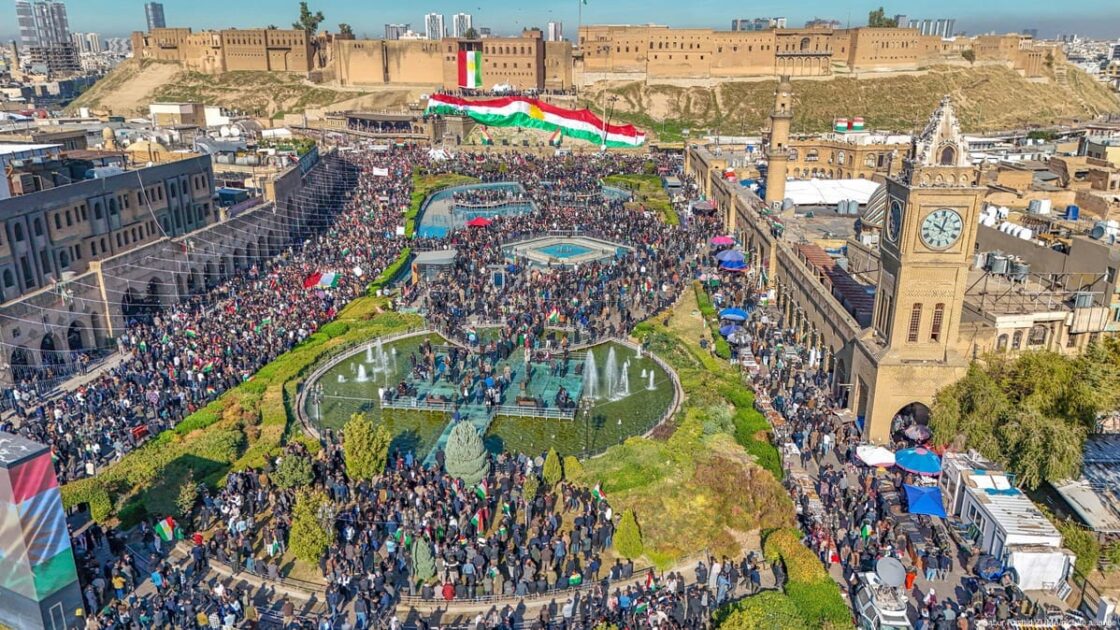
Large crowds gathered in Irbil early on Thursday, waving regional flags to protest federal government plans to take control of oil operations and border crossings in Iraqi Kurdistan. Iraqi Prime Minister Ali al-Zaidi announced the measures earlier in the week, stating that the changes were intended to halt oil smuggling.
Rival Kurdish Factions Unite
The announcement escalated a long-standing power struggle between Baghdad and Kurdish authorities, who have governed themselves largely since 1991. Rival Kurdish political parties joined forces for the demonstrations in the regional capital, while protests also spread to several other towns and cities.
Iraq’s 2005 constitution formally recognized the Kurdish region following the US-led invasion that toppled Saddam Hussein, but both governments have continuously clashed over land, oil, and financial resources. The cabinet of the Kurdistan Regional Government stated on Wednesday that Baghdad’s decision violates the constitution and constitutional rights, calling it an attempt to restore a centralized regime.
Disputed Territories and Legal Battles
Prime Minister al-Zaidi dismissed Kirkuk’s police chief, operations commander, and the head of the Border Ports Commission, describing the actions as a reflection of Iraq’s independent national will. Regional Prime Minister Masrour Barzani stated that his government was surprised by the decisions and deemed them completely unacceptable.
The Federal Supreme Court backed Tuesday’s decision, ruling on Wednesday that the authority of the Kurdish Regional Government is limited to the land it administered on March 19, 2003. The ruling transfers the management of oil fields in Kirkuk, Diyala, Salahuddin, and Nineveh, alongside regional border crossings, to federal oversight.
Article 140 of the 2005 constitution previously outlined a process to resolve the status of disputed territories through a census and referendum, neither of which took place. Kurdish peshmerga forces later expanded into these oil-rich areas following the withdrawal of Iraqi forces displaced by the Islamic State.
Internal political tensions within Iraqi Kurdistan have recently complicated regional governance, including a legal challenge regarding the current cabinet’s legitimacy. Despite these divisions, rival Kurdish factions have united in opposition to the federal government’s latest directives.