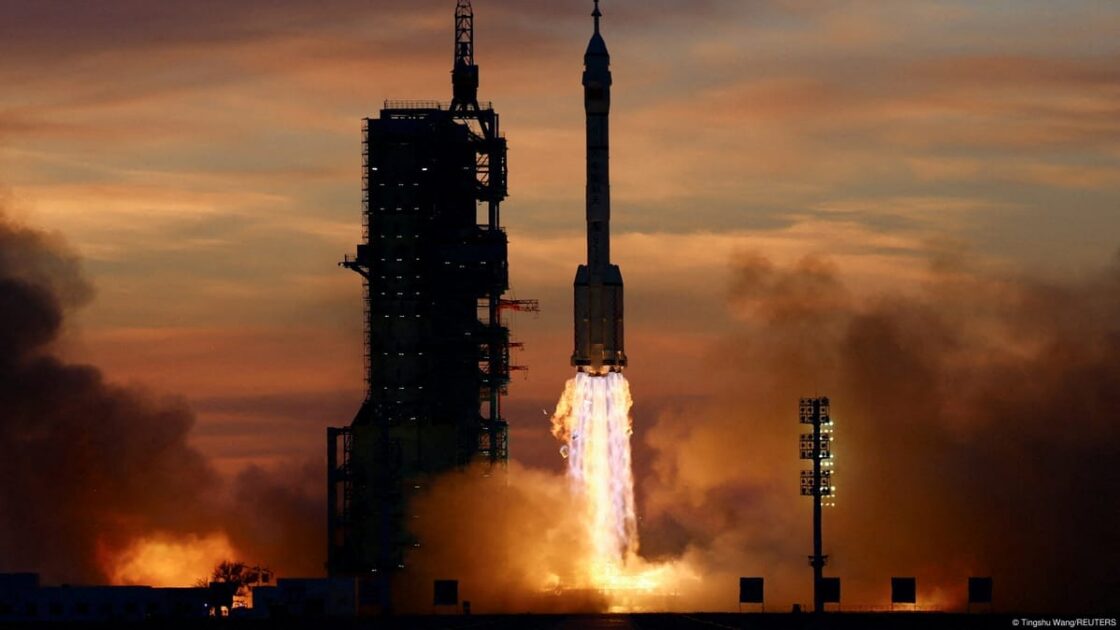
China successfully launched the Shenzhou-24 spacecraft aboard a Long March-2F rocket from the Jiuquan launch center in the Gobi Desert at 8:18 am local time.
Launch and Crew Details
The China Manned Space Agency announced that the capsule separated from the rocket roughly 10 minutes after liftoff, successfully entering orbit and marking the mission a complete success. State broadcaster CCTV broadcasted footage of the three crew members reviewing a manual shortly after launch and confirmed they were in good condition.
Tang Hongbo is undertaking his third spaceflight, making him the first astronaut to board the Tiangong station three times, according to CCTV. The mission also includes Wu Yi on his inaugural flight and Pakistani pilot Muhammad Zeeshan Ali, who marks the first foreigner to participate in a Chinese crewed space mission.
Speaking at a news conference, Muhammad Zeeshan Ali stated that he carries the name of Pakistan and the hopes of 250 million citizens on his shoulder, delivering his remarks in Urdu, Mandarin, and English.
Space Station Handover and Experiments
The orbital handover involves an unusual arrangement where Shenzhou-23 commander Zhu Yangzhu stays on the station for a year. Meanwhile, the remainder of his crew, consisting of Hong Kong’s first astronaut Lai Ka-ying and Zhang Zhiyuan, will return to Earth alongside Ali.
Zhu’s stay represents China’s first full-year orbital spell and sets a record for the longest single duration in space by a Chinese astronaut. This extended stay serves as an evaluation of human physiological endurance in preparation for upcoming lunar missions and potential voyages to Mars.
Xinhua reported that the newly arrived crew will perform over 90 scientific experiments and technology evaluations. During the pre-launch news conference, Tang noted that linguistic, cultural, and psychological differences presented initial teamwork hurdles, though mutual efforts successfully addressed them.
Ali expressed his dedication to the mission in Mandarin, comparing the endeavor to his daily training routine of continuously reaching new heights. China maintains its 2030 objective for a crewed lunar landing despite postponements affecting its Chang’e-7 moon mission, while the United States targets 2028.