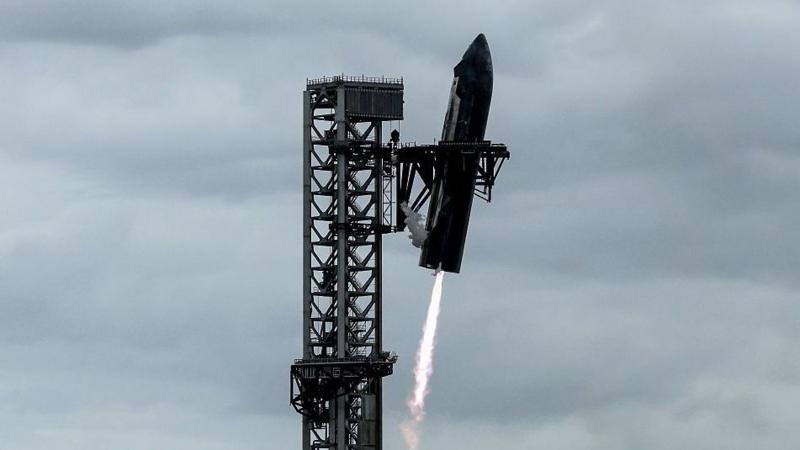
US regulators have granted SpaceX approval to launch one million satellites into Earth’s orbit for a project that will build data centres in space. The initiative, owned by Elon Musk, marks the first approval of its kind and aims to utilize sunlight to power satellites that process artificial intelligence (AI) data before transmitting results back to Earth.
The Starmind Project and FCC Approval
The Federal Communications Commission (FCC) stated on Wednesday that the project, named Starmind, would support the expanding superintelligence economy in America. FCC Chairman Brendan Carr remarked in a statement, as reported by BBC News, that the undertaking opens a bold new frontier for the computing infrastructure required to drive American leadership and growth.
Elon Musk responded to the decision on X by writing that it would be a major asset for America and the international community. Under the conditions of the FCC licence, the deployment of the satellites must commence no later than November 2033. SpaceX is mandated to deploy 10% of the network by November 2035, with that figure increasing to 50% by November 2038. The company has previously expressed its intention to launch the initial Starmind satellite next year, though it remains uncertain whether a million satellites will ultimately be launched or if the company requested a higher total than necessary.
Similar to the existing Starlink network, which utilizes more than 10,000 satellites to deliver high-speed internet, Starmind satellites will function in low-Earth orbit at altitudes between 500 and 2,000 kilometres. These satellites will link with Starlink infrastructure to relay data back to Earth.
Industry and Environmental Concerns
SpaceX argues that orbital data centres represent the most cost-effective and energy-efficient solution to satisfy surging global demand for AI computing power that surpasses terrestrial capabilities. Other corporations, such as Google and Blue Origin, are also investigating orbital data centre concepts as a greener alternative to traditional ground facilities, which consume massive amounts of electricity and water.
However, rival company Amazon has dismissed the proposal as a lofty ambition rather than a realistic plan. Meanwhile, the American Astronomical Society expressed deep disappointment regarding the regulatory decision, stating that the proposed constellation would significantly undermine federal investments in astronomical facilities and hinder public observation of the night sky due to the brightness and large number of objects.
Jan Hasselman, a senior attorney at Earthjustice, stated that expanding satellites directly impacts daily human life and planetary futures. Experts have also highlighted ongoing challenges, noting that launching hardware into space remains costly, complex to maintain and cool, and vulnerable to a growing volume of space debris and potential collisions.
Opposition to terrestrial data centres continues to mount locally, including in the US, where experts noted facility locations contributed to significant political losses for Republicans in recent midterm elections. While Starlink has faced accusations of causing space congestion, Musk has consistently rejected claims that his satellites crowd out competitors or occupy excessive orbital space.
Prof Sir Martin Sweeting, founder and executive chairman of Surrey Satellite Technology Ltd, told BBC Radio 4’s Today programme that while space data centres appear technically feasible, their large-scale viability requires further analysis, particularly regarding ground-to-satellite laser links that have not yet reached the capacity required for massive data transfers.