Four years ago, NASA sent a small spacecraft on a mission to demonstrate how humanity might deflect an asteroid heading toward Earth. The solar-powered space probe successfully crashed into the asteroid Dimorphos, permanently changing its orbit.
Investigating the Aftermath
Astronomers used telescopes to measure changes in the orbit of Dimorphos around a larger companion asteroid, Didymos, following NASA’s Double Asteroid Redirection Test (DART) mission. The spacecraft generated about 10 billion joules of energy when it struck Dimorphos in September 2022 at a speed exceeding 13,700 mph (6.14 kilometers per second). This impact shortened the asteroid’s 12-hour orbit around Didymos by roughly 33 minutes, which was 25 times more than the most conservative prediction.
However, scientists could gather only limited data because the collision destroyed the spacecraft as planned. DART captured images as it approached Dimorphos, but only distant telescopes and a small CubeSat that briefly registered the impact flash were able to observe the aftermath.
“We knew right away that the impact was successful, that DART made a really, really large mess,” stated Sabina Raducan, a planetary scientist at the International Space Science Institute in Bern, Switzerland. “However, we didn’t really know what kind of mess. We were still missing pieces of the puzzle.”
Hera Arrives at the Asteroid System
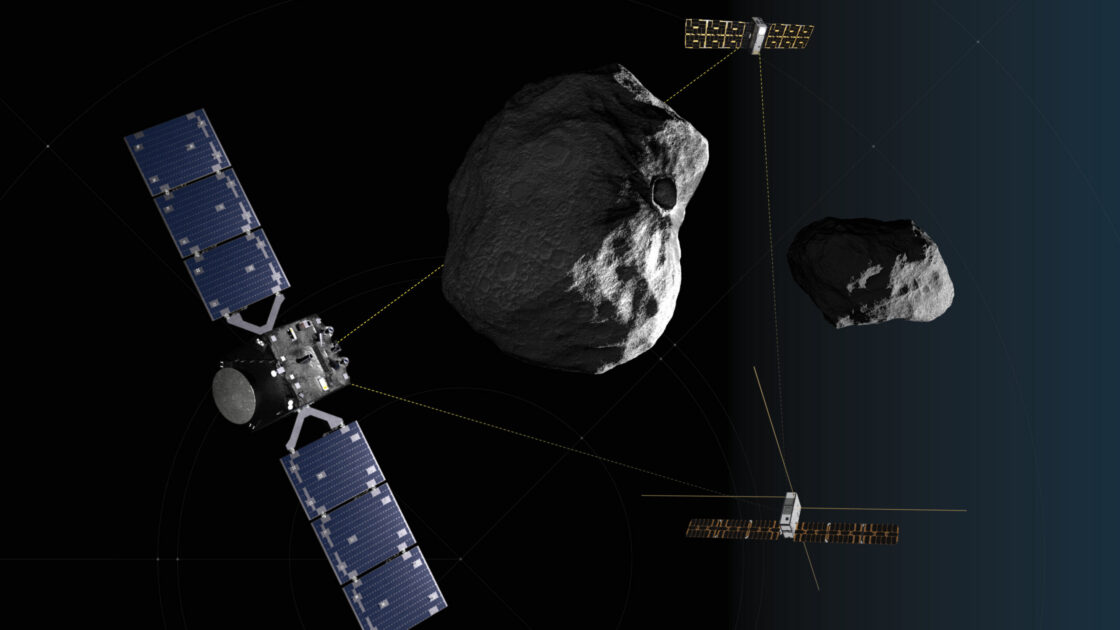
The European Space Agency’s Hera spacecraft recently reached the Didymos and Dimorphos system following a two-year journey from a launch pad in Florida. The European Space Agency released Hera’s initial images showing the scar created by DART on Dimorphos. The photographs reveal that the car-sized impactor excavated a stadium-sized crater that is nearly as large as Dimorphos itself, which is a rugged space rock measuring roughly 500 feet (151 meters) across.
Mission designers chose Didymos and Dimorphos for the deflection test because they resemble many near-Earth asteroids, while posing no threat of hitting Earth. Scientists remained uncertain what Hera would discover upon reaching the binary asteroid system, which currently orbits the Sun approximately 120 million miles (193.5 million kilometers) away from Earth.