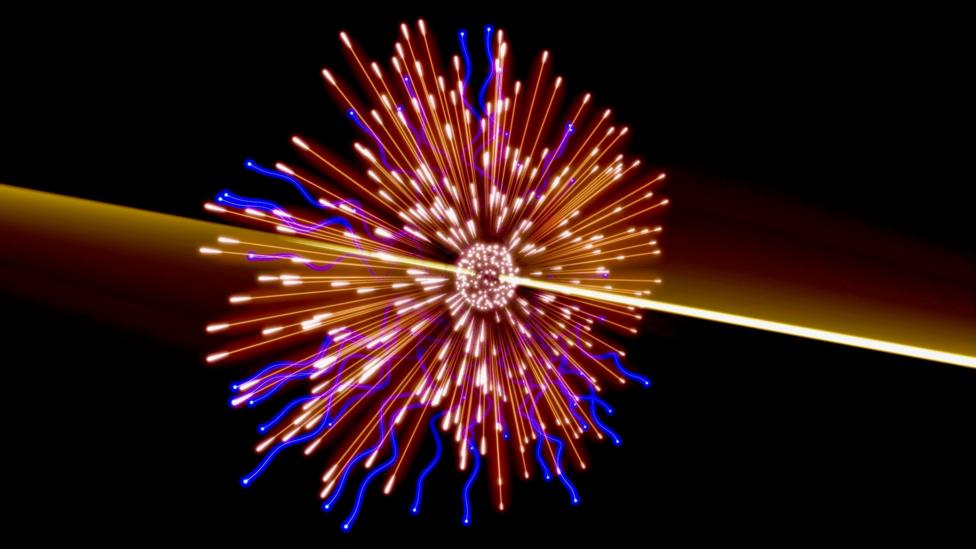
Scientists have detected signals from the smallest scale of nature ever explored, which is 100 billion times smaller than an atom. Researchers have nicknamed this unimaginably tiny realm the zeptoverse.
Probing the Zeptoverse at the Large Hadron Collider
The research was led by scientists based in Cambridge and obtained from an experiment at the Large Hadron Collider (LHC). Located at the European Laboratory for Particle Physics (Cern) on the Swiss-French border, the vast machine smashes atoms together to break them apart and discover their internal contents. This result is significant because it could assist researchers in developing a new, more complete theory of how the Universe functions.
Dark matter constitutes a major part of the cosmos, yet researchers have struggled to detect it. Scientists know it exists because its gravitational force influences normal matter, but it remains completely invisible in all other respects. In the experiment, particles were smashed together at high energy, and scientists studied the resulting shrapnel.
One of these sub-atomic particles is a beauty quark. The particle is unstable and exists for just one and a half trillionths of a second before decaying into other forms. Despite its short lifetime, researchers managed to detect it interacting with other tiny particles at a scale of a billion-trillionth of a metre. Certain theories suggest that particles at these scales are more sensitive to dark matter, which could influence how quarks interact and break down. Consequently, detecting activity in this tiny world could help scientists find dark matter.
Dr Harry Cliff of Cambridge University, who led the data analysis, told BBC News that they are knocking on the door of the zeptoverse. He stated that this sub-atomic dance provided researchers with a ringside seat to the behavior of possible new particles. Cliff added that they now want to go in, explore, and find what new particles are waiting there by obtaining more data.
Funding Challenges and the Future of UK Research
The 28 countries involved in the project agreed to a £150m upgrade to the Large Hadron Collider detector known as LHCb, which would increase the frequency of these decays tenfold. Cliff noted that this upgrade would allow them to probe inside the zeptoverse and see what is waiting.
However, the UK Research and Innovation (UKRI) agency, the government body responsible for research funding, announced last year that it was withdrawing its share of the money for the planned upgrade. UKRI later announced cuts to several other particle physics and astronomy projects, including Jodrell Bank’s iconic Lovell telescope.
Although Cambridge-based scientists led the research, Prof Tim Gershon, who leads the LHCb international collaboration, told BBC News that the UK’s full involvement in the research is now in doubt due to the cuts. He warned that the UK is at risk of missing out on major discoveries and failing to benefit from training young people who represent the nation’s greatest product. Early-career researcher Dr Mary Richardson-Slipper, part of the team that made the discovery, is reconsidering her future and looking at jobs abroad due to a lack of local opportunities, noting that many fellow fundamental physics researchers have already moved.
These cuts are occurring despite an overall record increase in the science budget. TV presenter and particle researcher Prof Brian Cox of the University of Manchester, who is not part of the research team, described the result as important but condemned the decision to cut UK funding for the Cern project. Cox stated that walking away from UK scientific leadership at this moment would be extraordinary, as it damages the future research program and harms the country’s international reputation.
The UKRI told BBC News that it remains a fully engaged member of Cern as its second-largest funder at around £175m per year. A UKRI spokesperson explained that the agency sought independent advice and advanced an exciting portfolio of new infrastructure investments, including clean energy, medical imaging, and cultural heritage projects, but noted that there were more funding applications than they could support.